

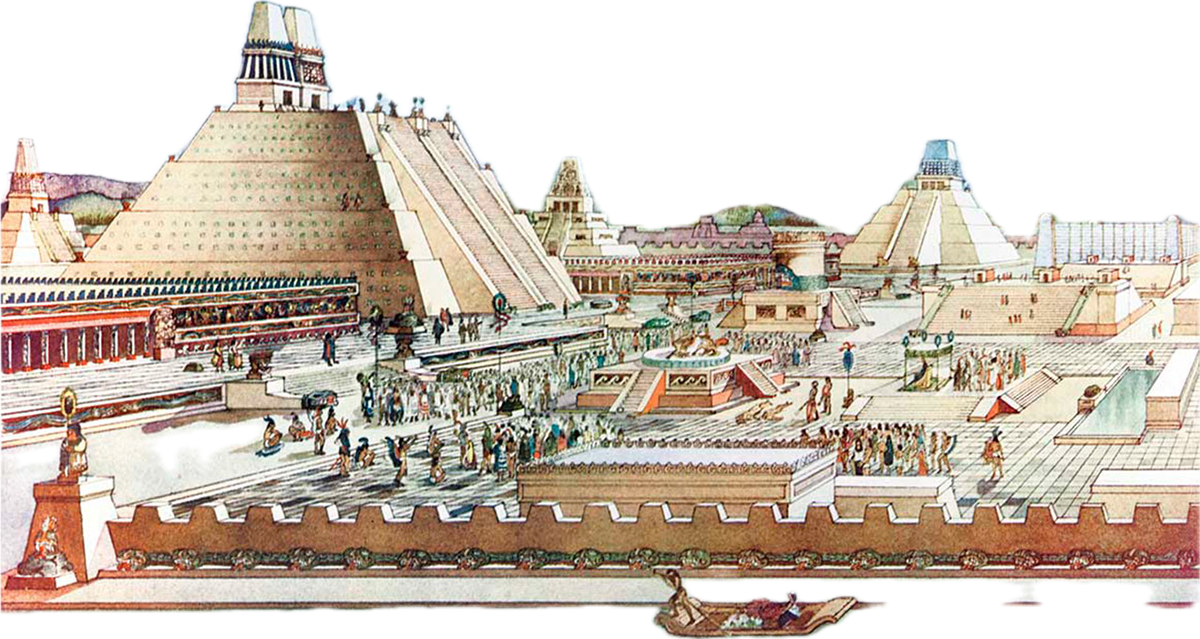
Templo Mayor (reconstruction), Tenochtitlán, Wikimedia Commons.
For fifteen thousand years, the Americas developed their own human story entirely separate from the civilizations of Europe, Asia, and Africa. Two continents populated by hundreds of distinct peoples speaking dozens of languages. They were societies that built cities, developed writing, mapped the stars, and engineered agricultural systems of extraordinary sophistication—without contact or cross-pollination with the Old World.
What did they build when they built these civilizations independently?
The answer is the same one history gives everywhere else. They built empires, conquered neighbors, enslaved captives, and extracted tribute from the weak. They sanctified hierarchy with religious authority and enforced obedience through violence. They did what human beings have historically done whenever they have accumulated sufficient power over one another.
The Americas before Columbus were not Eden. They developed the same human patterns found throughout the Old World.
The Altar at the Center of the World
In 1487, the Aztec emperor Ahuitzotl dedicated the expanded Great Temple of Tenochtitlán. It was at the heart of a city that was then among the largest on earth and the dedication lasted four days. War captives were brought to the summit, held down across a sacrificial stone, while their hearts were ripped from their living bodies and offered to the sun god.
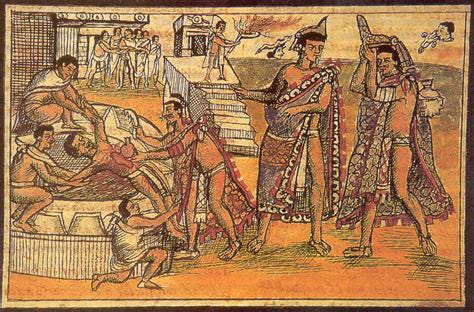
Aztec human sacrifice, Codex Magliabechiano, folio 70r (c. 1550). Via Wikimedia Commons
“Possibly twenty thousand victims died for that dedication: four patient lines stretching the full length of the processional ways and marshalled along the causeways, slowly moving towards the pyramid.” —Clendinnen, Aztecs
As they approached, priests met them to announce their privilege: to die in the dedication. At these ceremonies, Aztec kings invited the rulers of allied and enemy city-states to watch. The sacrifice was both an offering to the gods and a weapon aimed at the living.
“The ritual extravaganza was carried out with maximum theatrical tension, paraphernalia, and terror in order to amaze and intimidate the visiting dignitaries who returned to their kingdoms trembling with fear and convinced that cooperation and not rebellion was the best response to Aztec imperialism.” —Carrasco, City of Sacrifice
The Aztec Empire was built around human sacrifice. In its cosmology, the sun god required human blood to complete his daily journey across the sky. Without it, the sun would cease to rise and the world would end.
“The killings were not remote top-of-the-pyramid affairs… The people were implicated in the care and preparation of the victims, their delivery to the place of death, and then in the elaborate processing of the bodies: the dismemberment and distribution of heads and limbs, flesh and blood and flayed skins.” —Clendinnen, Aztecs
The flower wars were about the capture of high-ranking warriors worthy of the sacrificial stone—not territorial conquest. Neighboring peoples were kept intact and productive, raided on a schedule, because a dead province could not supply captives and a captive-less empire could not supply the altar.
Tlaxcala—the province that eventually fought alongside Cortés—was left deliberately unconquered because its finest warriors were among the most valuable sacrificial victims. Outside the temple stood the skull rack. Every skull on those poles was proof that the sun had been fed and the world preserved for another season. From the Aztec perspective, they weren’t engaging in wanton cruelty, they were being responsible.
When Cortés arrived in 1519, he found an empire encircled by peoples who despised it. The Tlaxcalans who fought alongside him were not betraying some pan-Indigenous solidarity. That did not exist. They joined Cortés because a new military power had arrived and they calculated their odds. The conquest of Tenochtitlán was, in large part, an Indigenous coalition war that had been building for decades—one that Cortés skillfully exploited.
The Pattern Holds
The Inca empire stretched four thousand miles along the spine of South America. Over roughly a century it absorbed more than eighty distinct ethnic groups through a machinery of coerced integration so thorough it relocated entire populations to break the bond between a people and their place. The mit’a extracted rotating labor from every subject community. The mitma moved peoples across the empire to serve imperial purposes, settling loyal groups in restive regions and dispersing potential troublemakers into unfamiliar territory among strangers who spoke different languages. It was an occupation administered with bureaucratic precision. When the Spanish arrived they found an empire weakened by a recently completed civil war and a collection of recently conquered peoples—many incorporated within living memory and some still under arms.
See my four-part series on the Incas starting here:
How 168 Spaniards Humiliated the Greatest Empire in the New World

Juan Lepiani — The Capture of Atahualpa (1920s)
The Maya, for most of the twentieth century, were imagined to be peaceful astronomer-priests. That fairy tale was shattered by decipherment of the glyphs. When archaeologists cracked the Maya script in the 1970s and 1980s, what emerged was not philosophical meditation on the movement of time that scholars had imagined. It was war records and victory proclamations. The ritual humiliation of defeated kings carved in stone for eternity.
The chronology tables read like a ledger: Ah-Cacaw of Tikal captures Jaguar-Paw of Calakmul. Caracol conducts star-war action against Tikal.
The classic Maya collapse, long attributed to drought or ecological overreach, appears to have involved sustained inter-elite warfare that systematically destroyed the administrative infrastructure on which urban life depended and hollowed out the political system from within.
The peaceful Maya of the popular imagination were a projection. The opposite of what the stones actually revealed.
The Comanche Empire
The Comanche arrived on the southern plains as refugees. Within two generations of acquiring the horse, they had become the most formidable mounted warriors in the Western Hemisphere. They drove the Apache from the southern plains and reduced Spain’s imperial presence in the Southwest to what Pekka Hämäläinen calls a fiction that existed only in Spanish minds and on European maps. They extracted tribute from Spanish colonial towns in Texas with the confidence of a power that knew it could take whatever it wanted.
Hämäläinen titled his study of this period The Comanche Empire, which lasted roughly from 1750 to 1850. His central argument is what he calls “Reversed Colonialism.”
“This book is about an American empire that, according to conventional histories, did not exist. It tells the familiar tale of expansion, resistance, conquest, and loss, but with a reversal of usual historical roles: it is a story in which Indians expand, dictate, and prosper, and European colonists resist, retreat, and struggle to survive.”
—Hämäläinen, The Comanche Empire
The Comanches built the largest slave economy in the colonial Southwest. Raiders swept through Apache villages and Spanish settlements, carrying off women and children to be traded at Taos and other border markets. The taking and processing of human beings from neighboring peoples was the commercial core of Comanche society.
Traders would “deflower and corrupt” captive Spanish women in public before offering them for sale. According to Hämäläinen, these public rapes served a market function. They demonstrated what captives would suffer if their families refused to ransom them, thereby legitimizing the trade and driving up prices.
The horse and the way they deployed it made the Comanche powerful. They used that power to dominate rivals, extract wealth, and build an empire.
The Nations They Scattered
The Iroquois Confederacy is often cited as evidence that North American peoples developed democratic and peace-oriented political institutions—and it is true that it achieved something remarkable in its internal governance. In the mid-seventeenth century, The Iroquois also conducted wars of annihilation against their neighbors that bore little resemblance to the diplomatic model they employed among themselves.
The engine was the mourning war—a pre-contact institution rooted in grief. When a lineage member died, that loss had to be replaced by a war captive adopted into the dead person’s place. European epidemic disease turbocharged the system. Thousands of deaths led women to demand continual mourning wars and young men to seize ever more captives. The institution was ancient, but the scale it reached was new.
Between 1647 and 1657, the Iroquois League destroyed or dispersed four neighboring nations. The Huron Confederacy was shattered. Fifteen villages were abandoned, their inhabitants scattering into forests and among islands “most unknown to the enemy,” in the words of the missionary Paul Ragueneau, who witnessed the catastrophe. The Petuns, Neutrals, and Erie were then demolished in quick succession.
These were campaigns of imperial annihilation, and they had a name for it. WE-HAIT-WAT-SHA: “a body cut into parts and scattered around.” This described the systematic destruction of a nation and a people’s collective identity. The concept was named, theorized, and remembered with pride. It was a sophisticated doctrine of imperial domination that developed entirely without European instruction.
By 1657, the missionary Paul Le Jeune believed that more foreigners than natives of the country resided in Iroquoia. The famous confederacy—a model of democratic self-government—had maintained its population largely by absorbing and consuming the nations around it. Internal peace and external conquest were the same system.
The Myth and Its Persistence
The noble savage myth refers to the idea that human beings in their natural state were free, peaceful, and uncorrupted, and that civilization itself was the source of violence and hierarchy. The peoples of the Americas were considered evidence of this vision. In the European imagination, they were proof that innocence was possible—that somewhere, before kings and priests and property, human beings had lived without domination.
The myth has not died. Today it appears in land acknowledgments that describe pre-contact peoples as living in harmony with the land, in films that portray Indigenous characters as spiritually wise victims of European brutality, and in curricula that treat the entire pre-Columbian period as a single peaceful civilization interrupted by conquest.
The myth has a mirror image—the view that Indigenous peoples were primitive dupes who lacked any capacity to resist European expansion or shape history themselves. Both visions deny the full range of human capacities to the people they describe. Both reduce complex historical actors to props in a story that is ultimately about Europe.
The peoples of the Americas were neither innocents nor helpless victims. They did not need Europeans to teach them conquest. They had developed their own empires, their own hierarchies, and their own systems of domination long before Columbus crossed the Atlantic.
The Control Group
Here is what the Americas show us that nowhere else can in quite the same way:
Two continents. Fifteen thousand years of independent development. No shared religion, no shared trade, no borrowed ideas, no contact with the civilizations of Europe, Asia, or Africa.
The Americas were the closest thing history provides to a control group—a human experiment running in parallel with the rest of the world, producing results that neither population could have influenced.
And they arrived at familiar destinations: empire, conquest, slavery, and tribute extracted from the weak by the strong.
They dominated their neighbors whenever they had the capacity to do so. They employed hierarchies sanctified by religion and enforced through violence. It was the same story, generated independently across two continents by people who had never heard of the Romans or the Mongols.
The details differed. The gods were different. The languages were different. So were the technologies. But the underlying patterns were familiar.
The same patterns emerged here as everywhere else on earth—without the supposed corrupting influence of the Old World.
It wasn’t Europeans that produced conquest. It wasn’t Christianity, capitalism, or white supremacy or any particular cultural tradition carried across the Atlantic in the holds of Spanish ships. It was something older and more fundamental than any of those things.
It was not the Old World. It was the human world.
Sources:
Inga Clendinnen, Aztecs: An Interpretation (Cambridge, 1991)
David Carrasco, City of Sacrifice: The Aztec Empire and the Role of Violence in
Civilization (Beacon, 1999)
Pekka Hamalainen, The Comanche Empire (Yale, 2008)
Daniel K. Richter, The Ordeal of the Longhouse: The Peoples of the Iroquois League in the Era of European Colonization (UNC Press, 1992)
Linda Schele & David Freidel, A Forest of Kings: The Untold Story of the Ancient Maya (Morrow, 1990)
What is mind boggling to me is that this is not new information, it has been common knowledge for, in some cases, centuries, yet professors, institutions, media, the education system, have been peddling absolute falsehoods, such as the “noble savage myth”, as fact since the 1800’s.
“We wish to acknowledge that the digital space currently occupied by Substack exists on the ancestral, unceded territory of the Media Elite—specifically the Upper West Side Consensus and the Legacy Gatekeeper tribes.
For decades, these traditional stewards controlled the flow of information from their sacred strongholds along the Acela Corridor. We recognize the enduring print heritages of the New York Times and the Washington Post, who deeply cultivated these editorial narratives long before the arrival of the independent newsletter settlers.We pay our respects to their Elders—the Executive Editors, Op-Ed Columnists, and Fact-Checkers—past, present, and emerging. We acknowledge the ongoing trauma caused by the disruption of their traditional monetization models and the forced displacement of their subscriber bases to decentralized platforms."